
14 games, Nov. 6/9/10, 2025
5566 +2/232\\
Week 10: 78 Touchdowns: 3 ATDs
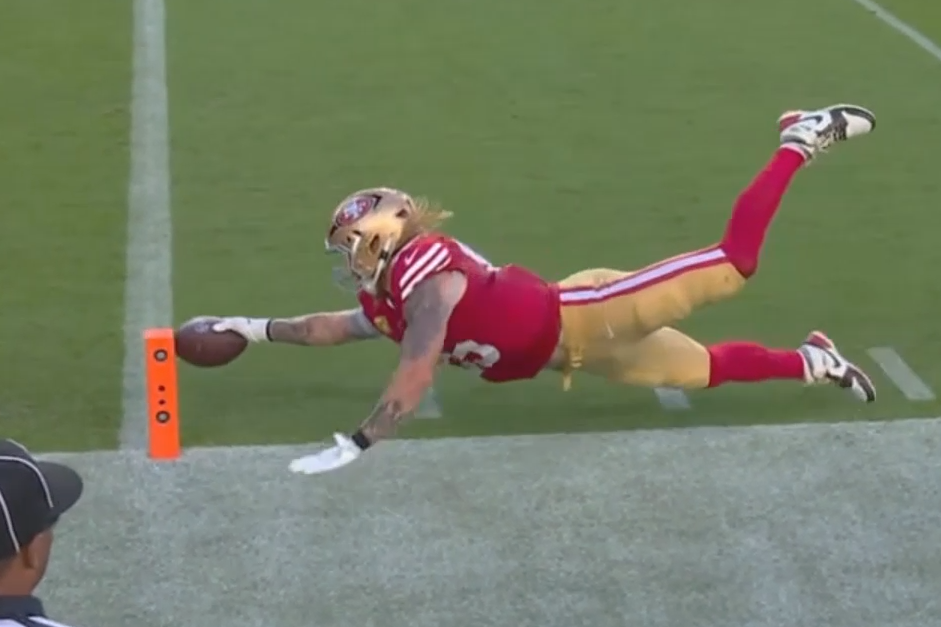
LAR@SF: All pylon, no end zone
A rulebook refresher: Playing Field Details, Field Markings subhead, point 5: “Pylons must be placed at inside edges of white lines and should not touch the surface of the actual playing field itself.” In other words, pylons are positioned out of bounds. Wholly, fully, 100 percent out of bounds.
Yet George Kittle reminds us once again that a ball carrier can completely avoid the end zone, poke a pylon — an out-of-bounds pylon — with the ball, and get credit for six points. Why this is true is an utter mystery.
Our theory: After foam pylons were introduced to pro football in Super Bowl VII (1973), some circus juggler suggested to league officials that pylons could be used as props to add entertainment value to the game. Give players an incentive to knock ’em down, like the milk bottle game on carnival midways, and people would perceive this as an exciting thing, a quirky test of skill.
Never mind that it makes no sense to award points for banging into an out-of-bounds object. Fans will eat it up. Poke the pylon; get a touchdown. Whee!
Plays such as Kittle’s pylon jab get heavy rotation on promotional clips. Commentators (Tom Brady in this case) marvel at the bodily contortions required to hit the target. Highlight reels load up on the replays. Rules analysts invoke the phrase “goal line extended,” as if that academic-sounding term will convince people that it makes sense to extend the reach of the goal line by four inches — the footprint of a pylon — into out-of-bounds territory at both sidelines. Why? Because people fall for gimmicks, and this gimmick has been conning football fans for decades.
We are in a tiny, tiny minority, but we’re not buying it. No way should this be a touchdown. Hocus Bogus Rating: 5

Video and images: Fox Sports
NO@CAR: Wide left
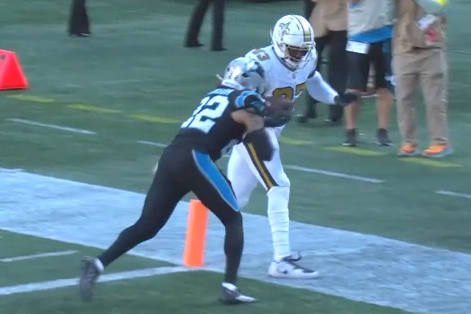
The Saints’ Juwan Johnson needs to make a business decision — step foot in the end zone, the traditional way to score a touchdown, or play dodge ’em with Carolina safety Lathan Ransom (22).
He sagaciously chooses the latter option, because the break-the-plane rule gives him permission to do so, meaning he can avoid a hit that could potentially dislodge the ball. (Ooo, good deal.) As he squeezes past the pylon, his first step beyond the goal line is out of bounds. Doesn’t that mean the end zone is actually wider than the field markings indicate? Shhh; keep your logic to yourself. Rating: 4
Video and image: Fox Sports
JAX@HOU: On the skids
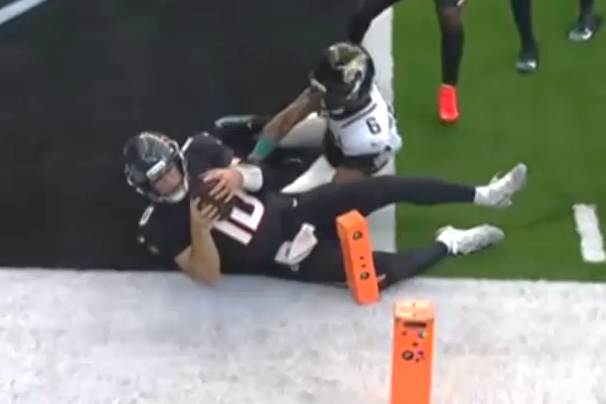
Houston’s Davis Mills completed a remarkable fourth-quarter rally (26 points scored in the final 12 minutes) with this goal-line dive with 30 seconds left in the game.
The break-the-plane rule gave him the go-ahead score, but he never quite got a body part into the end zone. His right leg nicked the sideline and pylon, an outcome due to the persistent pursuit of Jacksonville cornerback Greg Newsome II (6), who knocked him wide of the end zone.
It’s a close call. We have pondered a “momentum exception” to our proposed rule change for plays such as this, one that gives runners demonstrating genuine intent to reach the end zone a break-the-plane provision. Yet that puts officials in the position of interpreting intent, and that can be a murky world.
But it’s worth considering, particularly for high-velocity runners making goal-line dives. Our goal in this whole exercise is to remove the loopholes exploited by touchdown shysters who are aiming for cheap and (to us) illegitimate scores.
Not everyone will agree with us, but based on our purist perspective (that a touchdown requires a ball carrier to make inbounds contact with the end zone while the ball in his possession is at or across the goal line), for now we would rule Davis out of bounds and give Houston the ball inside the 1.
To us, Newsome should be the hero of this play. He kept Davis from contacting the end zone. Instead, the confetti falls on Davis, who to his credit appeared to be making every effort to actually reach the end zone. As so often happens with the existing rule, close calls favor the offense. Rating: 2
Video and image: CBS Sports